

The European Commission has set out a new vision for the future of European tourism, placing competitiveness, sustainability, resilience and digital transformation at the heart of its priorities. A key pillar of this digital ambition is the Common European Tourism Data Space (ETDS), which is being developed through the DEPLOYTOUR project. By bringing together European tourism stakeholders and building the foundations for secure data sharing, DEPLOYTOUR is helping shape the future of a more connected and data-driven tourism ecosystem.
A changing tourism landscape calls for a European response
Tourism plays a major role in Europe’s economy and society, contributing significantly to economic growth, employment and regional development. In 2025, the European Union welcomed close to 600 million international tourists, representing almost 40% of global international tourist arrivals. The sector directly contributed 4.1% to the EU’s gross value added, rising to 10.1% when indirect and induced effects are included. It also supports more than 20 million jobs and brings together around 5 million businesses, 99% of which are SMEs.
Yet this economic weight comes with significant challenges. Seasonality, uneven visitor distribution, environmental pressures, skills shortages and the digital transformation are reshaping the sector. At the same time, tourism businesses and destinations need better access to reliable data to anticipate trends, adapt to changing traveller behaviour and make informed decisions.
Against this backdrop, the European Commission published its new EU Sustainable Tourism Strategy on 4 November 2026. Building on the 2022 Transition Pathway for Tourism and the European Agenda for Tourism 2030, the strategy sets out a coordinated European approach to strengthening the sector’s competitiveness, sustainability and resilience. Among its priorities, one stands out for the digital transition: the full deployment of the Common European Tourism Data Space.
The EU Sustainable Tourism Strategy: three pillars for the future of European tourism
Success today is not just about breaking records year after year. The priority is to move towards a tourism model that improves residents’ well-being, protects the territory and supports long-term prosperity for local communities. Success also means reducing seasonality and spreading tourism more evenly throughout the year. In the Balearic Islands, efforts are gradually being made to achieve this, while also attracting higher-value and more conscious visitors.
And, of course, tourism should aim to minimise its environmental impact and move towards a more sustainable model. Tourism must be a driver of shared prosperity for the region.
The new strategy is structured around three main pillars. Together, they aim to make European tourism more competitive, sustainable, resilient and better equipped to respond to future challenges.
1.Boosting the competitiveness of EU tourism
The first pillar focuses on strengthening the competitiveness of tourism businesses and destinations, with particular attention to SMEs, which form the backbone of the European tourism ecosystem.
The Commission identifies several priorities:
- Supporting tourism SMEs through collaboration, simplification and access to tools that facilitate their green and digital transitions.
- Accelerating data, digitalisation and innovation, by improving access to high-quality, reliable data and encouraging secure data exchange across the tourism ecosystem.
- Developing skills and talent, notably through the creation of a European Tourism Academy to boost competitiveness and economic sustainability and make EU become a destination for talent, where skilled workers can thrive
- Improving connectivity and infrastructure, making travel across Europe more seamless and sustainable, including by strengthening the attractiveness of rail travel for tourists.
A particularly important element of this first pillar is the deployment of the Common European Tourism Data Space. The Commission stresses that access to, use of and secure exchange of data are essential for destinations and businesses to adapt to changing market conditions and traveller behaviour. It also calls for stronger operational links between the Tourism Data Space and other European sectoral data spaces, alongside greater awareness among stakeholders of the benefits of data sharing.
2. Strengthening sustainability and building resilience
The second pillar recognises that the long-term competitiveness of European tourism depends on its economic, social and environmental sustainability.
The strategy highlights several interconnected priorities:
- Accelerating the clean and circular transition and strengthening environmental protection, particularly in the context of Europe being the fastest-warming continent, through, for example, the implementation of business models based on circular economy practices and innovation (reducing food waste, improving water management in tourism destinations and encouraging the use of renewable energy…).
- Promoting balanced and sustainable destination management, addressing seasonality, overcrowding and the uneven distribution of visitor flows. Among other initiatives, the Commission will propose an EU Model for Tourism Management to help destinations adopt more balanced and sustainable approaches.
- Advancing accessibility and inclusion, ensuring that tourism opportunities are available to a wider range of travellers.
- Strengthening crisis preparedness and resilience, helping destinations and businesses anticipate and respond to climate-related, geopolitical and other disruptions.
This calls for integrated, data-driven management approaches and trusted cooperation across the tourism ecosystem, recognising that protecting the environment and strengthening resilience are essential to preserving the very foundations of tourism.
3. Enhancing international cooperation and outreach
The third pillar aims to strengthen Europe’s position as a leading global tourism destination. It focuses on reinforcing international partnerships, developing cooperation with key global organisations and promoting a stronger, more coordinated European tourism identity.The strategy also seeks to encourage cooperation between destinations and regions, support joint tourism initiatives and showcase Europe’s cultural and territorial diversity.
Beyond these three pillars, the Commission highlights the importance of investment and effective governance. A stronger cooperation framework, bringing together European institutions, Member States, regional and local authorities and private stakeholders, will be essential to translating the strategy’s ambitions into concrete action.
Turning the EU Sustabinable Tourism Strategy into action:the role of DEPLOYTOUR
Among the priorities outlined in the strategy, the deployment of the Common European Tourism Data Space is particularly significant for the future of the sector:
"To ensure access to high-quality, reliable data for destination management organisations (DMOs), businesses, individuals and policymakers at all governance levels, it is of utmost importance to fully deploy the Common European Tourism Data Space. Further work on the Common European Tourism Data Space is needed to ensure strong operational links with other European sectoral data spaces and relevant data models. The Commission calls on Member States to strengthen stakeholders’ awareness of the purpose and benefits of data sharing and of the Common European Tourism Data Space."
COMMUNICATION FROM THE COMMISSION TO THE EUROPEAN PARLIAMENT, THE COUNCIL, THE EUROPEAN ECONOMIC AND SOCIAL COMMITTEE AND THE COMMITTEE OF THE REGIONS, EU Sustainable Tourism Strategy
Building a trusted and connected European tourism data ecosystem
Launched to support the deployment of the Common European Tourism Data Space, DEPLOYTOUR brings together 43 organisations across 13 Member States, representing different parts of the tourism value chain. Through five pilot projects across Europe, the project explores how data sharing and interoperability can address real challenges faced by tourism destinations and businesses.
Its work contributes to several of the foundations identified by the European Commission as essential to the Tourism Data Space:
- Data access and sharing: encouraging public and private organisations to share and make better use of their data.
- Trust and governance: supporting a framework in which stakeholders can collaborate and exchange data securely.
- Interoperability and cross-sector collaboration: connecting tourism with other sectors and data spaces, recognising that tourism is part of a wider ecosystem involving, mobility, skills, green deal and other domains.
By testing practical approaches through its pilots and bringing together stakeholders from different countries and sectors, DEPLOYTOUR helps turn the concept of a European Tourism Data Space into tangible applications.
The ambition is not simply to make more data available, but to create the conditions for data to be shared, understood and used effectively, supporting better decisions and new opportunities across the tourism ecosystem.
Developing skills and raising awareness: making data spaces concept accessible to tourism stakeholders
Technology and infrastructure alone are not enough to make a European data space successful. Its deployment also depends on the ability and willingness of organisations to understand, adopt and actively participate in data sharing.
This is why awareness-raising and capacity-building are essential components of DEPLOYTOUR’s work.
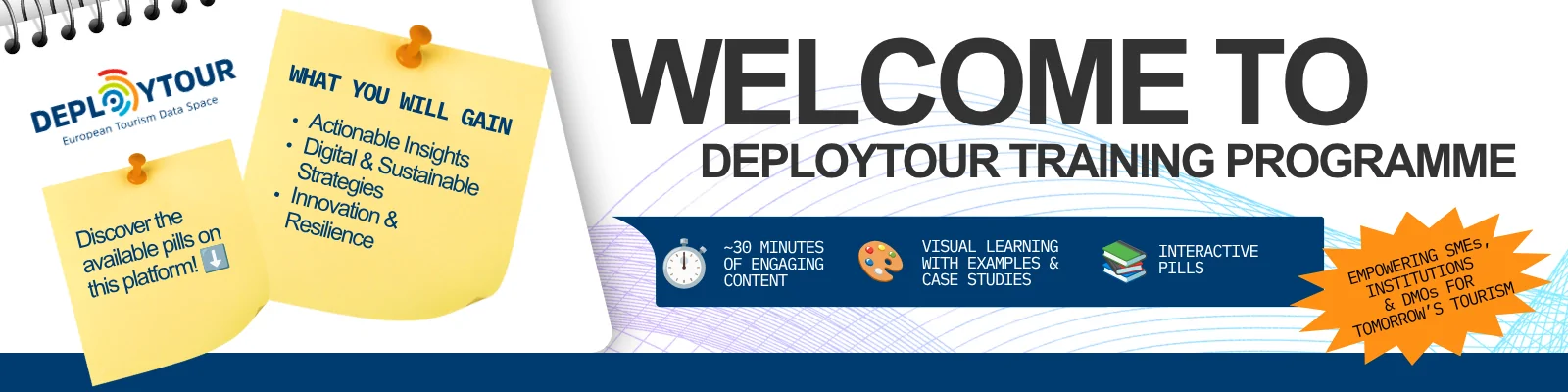
Through its training programme, the project aims to make data spaces, data sharing and interoperability more accessible to tourism stakeholders. By providing learning resources and practical knowledge, it helps organisations better understand the opportunities offered by data and how they can become part of this evolving ecosystem. This work is particularly relevant in light of the new European strategy, which highlights the importance of developing digital skills and supporting tourism businesses in their digital transition.
DEPLOYTOUR also contributes to this objective through its podcast series, “DEPLOYTOUR: Tourism meets Data – Connecting data, people, and places for the future of European tourism.” By bringing together experts, policymakers, destination managers and industry representatives, the podcast explores the challenges and opportunities of data sharing in tourism. It gives a voice to the people shaping the sector’s digital transition and illustrates how data can support concrete applications, from smarter destination management to more sustainable tourism practices.

With a focus on real experiences and practical examples rather than technical jargon, the series helps make the concept of data spaces understandable and relevant to a wider tourism audience.
The EU Sustainable Tourism Strategy sends a clear message: the future of European tourism depends on stronger cooperation, better use of data and the ability to turn digital innovation into tangible benefits for destinations, businesses and communities.
The Commission’s recognition of DEPLOYTOUR confirms the relevance of the foundations already being developed by the project. However, full deployment will require continued commitment, wider stakeholder participation and stronger connections with other European data spaces. By combining technical development, real-life pilot applications, stakeholder engagement, training and knowledge-sharing, DEPLOYTOUR contributes to this collective effort.
Building a European Tourism Data Space is not only a technological challenge. It is about connecting people, organisations and data to create a more collaborative, competitive, resilient and sustainable tourism ecosystem.