Podcast Tourism meets data – Episode 1 with Dolores Ordoñez.
In our first podcast episode, we spoke with Dolores Ordoñez, General Director of AnySolution and coordinator of DEPLOYTOUR, about how tourism can position itself as a key pillar of Europe’s data economy. Through DEPLOYTOUR, the ambition is clear: integrate tourism into the European data strategy and unlock the power of data and AI to build a more resilient, competitive and sustainable sector.
This article explores the key takeaways from that conversation.
Growing sector, a growing set of challenges
Tourism is a growing industry — and with growth comes an ever-expanding set of challenges. All indicators point to continued expansion in the years ahead, bringing with many challenges, each demanding its own response.
Some destinations are buckling under the pressure of overcrowding, requiring smarter management of visitor flows. At the same time, the sector must reconcile that growth with environmental and social sustainability.
Adding to the difficulty is the fragmentation of the ecosystem. Since SMEs and micro-SMEs account for 99% of the tourism sector, coordination, data collection, and decision-making are inherently difficult. Data and AI (Artificial Intelligence) can help, but only if they are accompanied by education, capacity building, and the right governance frameworks.
Siloed data is holding destinations back
To manage a destination well, destinations needs a complete picture: visitor numbers, yes, but also environmental data, mobility patterns, cultural heritage metrics, labour market trends, and more. Today, that information is scattered across different departments, sectors, and organisations, making it nearly impossible to act on in a joined-up way.
This is precisely the problem that data spaces are designed to solve: creating a shared environment where datasets can be discovered, described, and exchanged — without requiring anyone to hand over their data unconditionally. By bringing these different data sources together, SMEs (Small and Medium Entreprises) and DMOs (Destination Management Organisations) can finally access the full picture they need to make better and more informed decisions.
Many destinations claim to be sustainable. But without data, that claim is difficult to substantiate or act upon. What is the energy consumption baseline? What is the social impact on local communities? How is tourism affecting the labour market?You cannot manage what you cannot measure. Better data allows destinations to establish where they actually stand, track progress against clear indicators, and make genuinely informed decisions. It also enables forecasting and simulation, helping destinations anticipate future pressures rather than simply react to them. Resilience, in other words, is built on data.
The European Tourism Data Space
To adress this challenges, DEPLOYTOUR is developing a trusted and secure Common European Data Space for Tourism to enable secure, interoperable and governed data sharing across the tourism ecosystem.
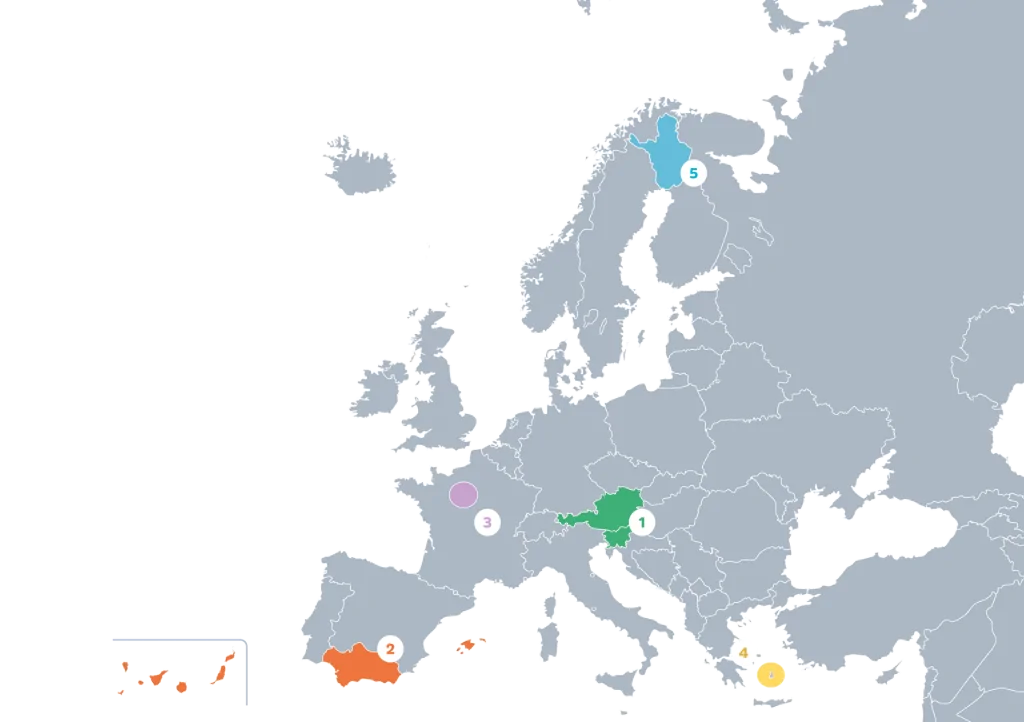
Five pilots have been defined to reflect the diversity of European tourism:
- Sustainable Tourism Management of Alpine Tourism between cross-border destinations, Slovenia and Austria;
- Mature Destination Resiliency and Competitiveness in Canary Islands, Andalusia and the Balearic Islands (Spain);
- Supporting the competitiveness of the MICE sector in Paris Region (France);
- Leveraging cultural heritage to diversify tourism offer: the case of Ano Syros (Greece);
- Empowering SMEs in Tourism through a Collaborative TravelTech in Lapland (Finland).
These pilots are tackling key challenges in tourism. They showcase varied destinations, offerings, and data-sharing models, proving the viability of the data space in real-world scenarios and advancing the creation of the European Tourism Data Space.